Quick answer
The complaints owners raise about FlexArmor are mostly about cost, a finish that’s textured rather than glass-smooth, repairs that mean cutting and respraying the roof, parts the warranty doesn’t cover, and individual shops that communicated poorly. Leaks through the FlexArmor itself are rarely reported.
We sell FlexArmor roofs, so you’d expect us to skip this page. We wrote it because you’re going to search for it anyway, and you should hear the downsides from someone who will also tell you which ones matter. These come from owner forums, RV publications, FlexArmor’s own reviews and its warranty terms.
1. It costs more upfront
The most common complaint by far. A FlexArmor roof costs more than resealing or a roll-on coating, and on an older, low-value RV the numbers may not work. It often costs about the same as, or less than, a new rubber or TPO roof.
Our take: fair complaint. If you’re selling soon or the RV is near the end of its life, a repair or coating is the better buy. We cover this in 5 reasons FlexArmor might not be right for your RV.
2. The finish isn’t perfectly smooth
FlexArmor is sprayed, so the texture follows the roof underneath and the fixtures it’s sprayed around. FlexArmor says the finish is usually comparable to fibreglass, and any pitting is shallow. No two roofs look exactly alike.
Our take: it’s a working roof, not a showroom finish. If a perfectly uniform look matters to you, ask to see finished roofs before you book.
3. Changing things on the roof later takes a shop visit
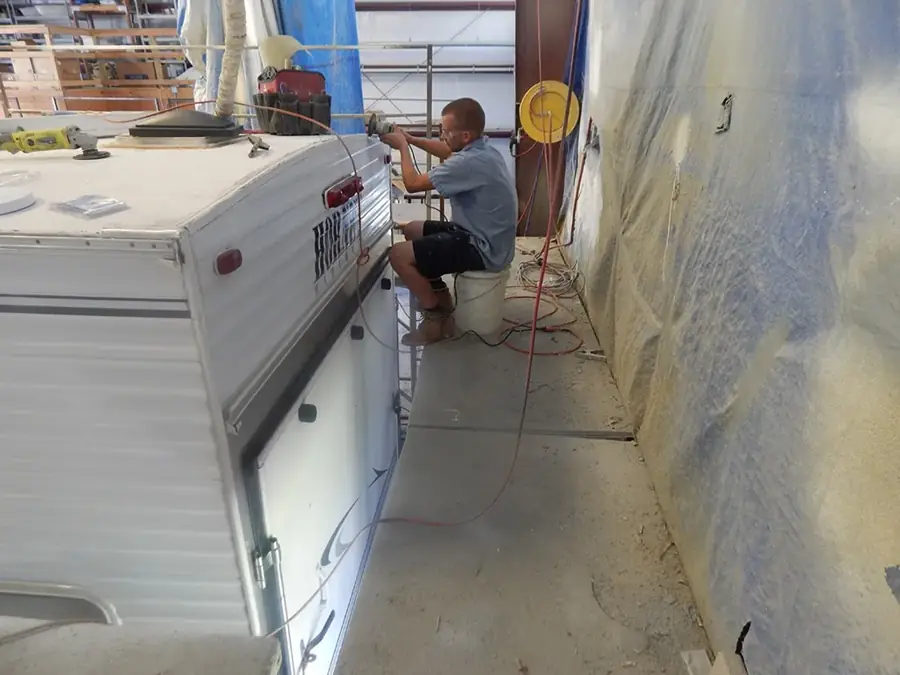
Once the roof is one sealed layer, you can’t just pull a vent and add a bead of caulk. Adding solar, swapping a vent or fixing a gutter or front cap means cutting into the coating. One RV technician has written about this at length: moldings, caps and gutters on some RVs eventually need work, and that work goes through the coating.
Our take: true, and it’s the trade-off for having no seams. The repaired area is cut out and resprayed, not the whole roof. Under the warranty, anything cut or drilled into the roof has to be resprayed at an authorized FlexArmor location within six months. On the road, a temporary seal holds until then. If you know you want solar, plan it into the original job.
4. Some parts aren’t covered by the warranty
The lifetime no-leak warranty covers the roof and the FlexArmor layer. It doesn’t cover TV antenna boots, AC gaskets or cracked skylights above the coating line, and it doesn’t pay for damage to the RV or its contents. Owners also have to register the warranty within 30 days, and a new owner has to re-register within 30 days of buying.
Our take: those parts wear out on any roof. We replace brittle ones during the job, register the warranty with you before you drive away, and link the full warranty so you can read it first.
5. Hail can still damage what’s on the roof
Owners report FlexArmor roofs coming through hail with no damage to the roof itself. The plastic parts on top are a different story. One owner’s fifth wheel came through baseball-sized hail with zero roof damage, but the AC units were damaged.
Our take: FlexArmor protects the roof, not the AC shroud or vent lids. Tougher vent lids during the job help.
6. Does it trap moisture underneath?
Some RV repair shops have raised this concern about sprayed roofs. It would be a real problem if a roof were sprayed over wet or rotted wood.
Our take: that’s why the roof is opened up and checked first. Soft or rotted decking is cut out and replaced before anything is sprayed. We won’t spray over a wet or damaged deck.
7. The shop matters as much as the product
The negative reviews in the FlexArmor network are mostly about the shop, not the roof: slow replies, a vent removed without asking, a requested sample that never arrived, solar brackets reinstalled without lock washers. Positive reviews praise the opposite: progress photos, invoices that matched the quote, and finish dates that held.
Our take: this is the one we control. You deal with the owners, the quote is the invoice unless you approve a change, and we stop and ask before doing extra work.
8. Spring books up early
Owners report FlexArmor shops booked months ahead in spring. One shop was full through May by February.
Our take: book in fall or winter. You aren’t using the RV, and we can store it until spring.
The pattern: FlexArmor’s weak points are cost, flexibility for later changes, and depending on a good shop. Its strong point, no seams and no resealing, is exactly what most owners are paying for.